I first heard about the hCG protocol from my sister, a registered dietitian. She’d already finished her first week on it before she called to tell me about her experience. I’m sure she waited because she expected me to criticize what she was doing.
You could say I was skeptical, considering I’m a personal trainer, and my college degree is in exercise physiology. Obviously eating less than 500 calories in food causes weight loss, but what about muscle loss, too? Destroying your metabolism? And preparing you for what? You can’t eat 500 calories the rest of your life! Yes, I was critical.
At the time, I thought I was thoroughly informed as to how the body uses fuel, and how the body responds to starvation. Before I read Dr. Simeons’ 1967 manuscript, Pounds & Inches, I assumed it was written by a con man taking advantage of our desperation due to the obesity crises. But to my surprise, the manuscript made some sense. I could relate to his theories because his observations of fat gain and loss paralleled my own during three pregnancies, and what I’d witnessed with many clients over my ten-year career.
I’d observed, measured, and assessed body fat compositions for thousands of people. Some of those clients meticulously exercised and reduced their food intake—without results. I watched as female clients gained abdominal fat during menopause, even though they were eating less and exercising more. I observed clients before, during, and after pregnancy, and witnessed the shape of their bodies change, adding fat in some areas, and losing it in others. I knew through experience that fat gain and loss were linked to hormones.
I was excited when Simeons’ observations validated mine.
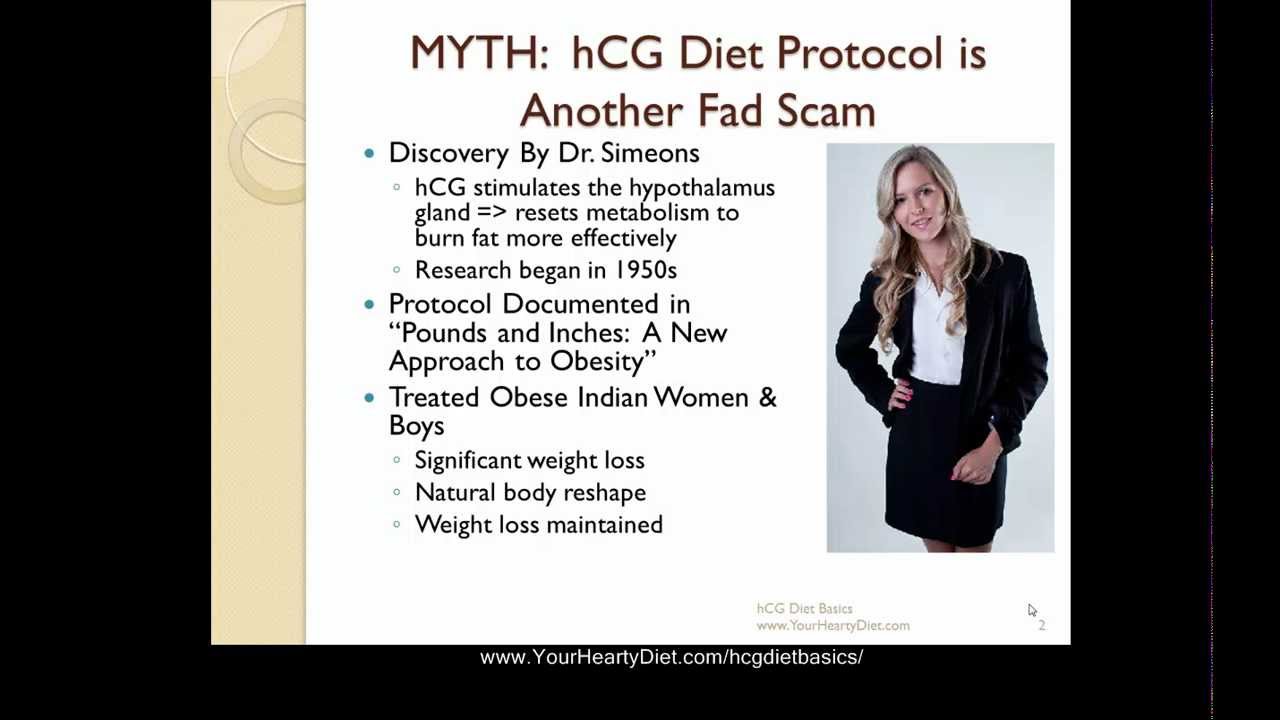
Dr. Simeons assessed scale weight for decades to deduce the strict guidelines of his protocol. He had theorized, based on his observations, that the pregnancy hormone, human Chorionic Gonadotropin (hCG), somehow prevented symptoms of starvation during a 500-calorie protocol. In 1967, he privately published his findings and hypothesis in a manuscript called Pounds & Inches: A New Approach to Obesity. Dr. Simeons’ believed the brain determines where and when fat is used for fuel. He observed that hCG redirected the brain to use abnormal fat (fat that’s difficult to lose) for energy. He observed that 1) participants felt minimal hunger, 2) their weight loss was rapid, and 3) their losses were specific to areas that regular diet and exercise didn’t influence.
Dr. Simeons was convinced that by tricking the brain with hCG, and manipulating fuel demand with the 500-calorie protocol, the brain would “re-set” its fat-burning capacity. Ultimately, this would allow the participant to eat normally without having the same susceptibility for fat gain when the protocol was over.
After understanding his protocol, and finding a doctor willing to prescribe it, I decided to present the information, as well as the opportunity to do the protocol, to appropriate clients. They had to allow me to follow, measure, and record their progress, and in particular, compare their metabolic rate before they started, and after they finished.
Six clients agreed to participate. Before starting the protocol, I did a battery of tests. These included a record of: metabolic testing to find out how many calories they burned in a day, a cardiovascular endurance test done on a treadmill, blood pressure, resting heart rate, flexibility testing, push-up and sit-up tests for muscular endurance, bench press to measure their estimated strength, two different body-fat composition assessments, as well as circumference measurements.
I continued to measure everything weekly during and after the 500-calorie protocol, except for the fitness testing and metabolic rates, which I measured again at the end. I wasn’t surprised by their significant fat and size loss but I was not prepared for the drastic amount of fat lost in the stomach area. Quickly I added three additional circumference measurements to that stomach area to ensure I was accurately assessing their size change.
All participants agreed they had minimal hunger, and most said their energy level was good. Completely shocking were the fitness and metabolic testing results after the protocol was completely over. Not only did the fitness tests improve, but the amount of calories their body burned in a day significantly increased. Considering each participant ate less than 500 calories for over a month, these results were astonishing.
I knew there had to be a logical explanation. I worked with new clients on the protocol, and continued to perform all of the tests before, during, and after the protocol. After collecting data for over 40 people, a local university statistically analyzed my metabolic testing results. When the results came back they were the same as my own observations. The metabolic rates significantly increased after the protocol. At this point, I was determined to find legitimate reasons for the increase.
After all, my findings completely conflicted with everything I was taught regarding calories, fat loss, muscles, metabolism, and what’s supposed to weaken during chronic starvation.
I compiled the data, and searched for local doctors of endocrinology that specialized in organs and hormones of the body, hoping they would be interested in my findings. I assumed they’d be able to explain how the hCG could influence the body in a way that prevented typical symptoms of starvation during such drastic caloric restrictions. I wanted to know why all my participants had overall improvements, after the fact. Only one doctor was willing to meet with me. After 45 minutes of discussing what I’d been doing, and my hope for some answers, he suggested I create a hypothesis that might make sense of what I observed. I was taken aback that he didn’t have any answers, and that I would have to do my own research to understand what I’d been witnessing.
If this endocrinologist, who had a Ph.D., and also owned his own diabetes center, couldn’t help, then I was definitely on my own. That evening I started from square one, searching for scientific explanations for the physiology of hunger, energy, fueling, and how the body regulates fat metabolism, starvation, etc. This was a huge undertaking that required the ability to read scientific journals and reports to understand the cellular physiology.
Fortunately, my degree focusing on physiology came in handy. However, I was not prepared for what I found—thousands of medical journals written since I graduated in 2000— describing new hormones, new mechanisms, and new explanations for how the body regulates metabolism, hunger, and its complex fueling systems.
For two weeks I spent 12 hours a day, cross-referencing, reading and re-reading material over and over. I created charts and my own dictionary of organs, hormones, and functions, basically teaching myself the new physiology of energy homeostasis/equilibrium. The difficulty was not in finding the answers, but in understanding the new terminology and mechanisms I was not taught in school, or with any of my certifications.
Once I understood the most influential hormones involved in hunger and metabolism during both starvation and feeding, I formed a hypothesis that made the most obvious sense to me. Based on the modern science I studied, hCG must stimulate sufficient leptin in order to prevent all symptoms of starvation.
I felt like I was about to answer a million-dollar question, because I was so confident that the link between hCG and leptin had to be the answer. Within seconds of entering those two key hormones into a search engine, all of my hard work and focus became worth the effort. Immediately I found studies that connected hCG to leptin. Some specifically indicated the most powerful relationship between the two hormones occurred at almost the exact amount Dr. Simeons prescribed for the hCG protocol. My heart was racing, and I literally jumped up and down with excitement.
Not only did scientific evidence exist that could easily explain how hCG, through the stimulus of leptin, could prevent symptoms of starvation during a very low-calorie diet, but a huge body of science also explained the reason for significant metabolic increases. Any scientist involved in the new studies of the hormone leptin, as it concerns starvation, fat gain, and fat loss, would find the answer obvious. The only reason a person would have minimal hunger, increased energy, and wouldn’t experience lean tissue loss during a 500-calorie protocol, is if hCG adequately stimulated blood leptin levels.
I wrote a hypothesis, but unfortunately the doctor who suggested I find the answers never responded. I continued to collect data and be amazed at the protocol’s physical results. Today, I’ve closely monitored over 500 people through protocols, and continue to follow Simeons’ method. However, I use only modern science to explain how it works.
I’ve met with doctor after doctor, but so far all of them have been unaware of the new science, and most haven’t a clue as to the function of leptin. The protocol “experts” on TV, or who’ve written books on “new and improved” protocols, have yet to even mention new science, and continue to reference Dr. Simeons’ outdated and insufficient theories. It’s not surprising, considering the amount of time, effort, and extensive research it took for me to educate myself to formulate an answer.
Each person I met with to discuss the protocol, continued to reference what he found on the Internet, which is based on misinformation that inaccurately explains the protocol.
But, with the lack of relevant scientific explanation, and the majority of hCG sold on the Internet by people who aren’t necessarily educated in weight loss or human physiology, it makes sense to repeat the theories found in Simeons’ manuscript. No other explanation is out there. Unfortunately, there are many people attempting the protocol don’t follow it the way Dr. Simeons intended.
Most participants are completely unaware that eating and hCG directly influence the hormonal response from all of the organs in the body, and without strict compliance to the protocol, there could be harmful consequences. It’s approached like a diet, and businesses have started to manipulate and change the protocol to increase their profits and to make it more appealing to the masses. It’s unfortunate, considering the decades of observation and work it took Dr. Simeons to deduce the specificity of protocol. But Dr. Simeons didn’t really know how the protocol worked either, and even he admitted laboratory explanation and proof was needed.
If he had known what was going to happen with our culture, as it concerns over-eating and obesity, and the lack of integrity in the hCG diet industry, he would have written and presented the protocol differently Dr. Simeons didn’t foresee his protocol would be used, prostituted, and misdirected as a short-term fix by the consumer. He had no idea we were going to have a massive, cultural, emotional eating disorder, and that we’d continue to blame the consequences of fat gain on everything but ourselves. Just because you have minimal hunger, doesn’t mean you won’t eat. Just because you have significant fat loss, doesn’t mean you will be motivated to change the way you eat forever.
My goal in writing this book is to start a new conversation about Dr. Simeons’ protocol that has relevance, not only as a hormonal therapy, but as a means to end our national eating disorder. Instead of continuing to apply the protocol as a short-term diet, I’d rather it be discussed as a real solution, a tool to end irrational eating for emotional fulfillment. We are dealing with a crisis that is an addiction to emotional eating, and the obvious result is the overwhelming increase in obesity.
Think about the number of people in our culture who eat without hunger. How many people eat to gratify emotions? How many eat because they’re bored? When you observe our nation’s behavior with food, it’s very clear that fat isn’t what we should be obsessed about, and weight shouldn’t be the target of the problem. We need a genuine desire to eat less, one that isn’t dependent on weight loss as a reward. This requires each of us to be accountable for our own emotions, and find happiness in life not centrally stimulated by food.
· Can you find a different hobby when you’re bored, instead of eating?
· Can you deal with stress without using food as a pacifier or distraction?
· Can you create happiness without having to eat?
If you can, then eating less would not be such a big deal, and you wouldn’t have to pay for a diet to help. For most people, eating is almost entirely an emotional decision and behavior. If we forced the majority of our society to eat functionally, it would be torture for them, especially if you didn’t allow them to monitor their weight.
Even if someone has little hunger, and no symptoms of starvation, his or her emotional distress is far worse than the physical when it comes to eating less on the protocol.
We’ve created a society that is so emotionally connected to eating that any form of restriction feels like punishment. Shouldn’t there be some personal accountability? Look at the overall implications that emotional eating has on medical costs, health care, and the occurrence of disease directly linked to obesity. However, the decision to find emotional strength without eating must come from an individual’s internal desire. It can’t be forced; otherwise we’ll end up with even more psychological problems.
As more and more people choose to free themselves from emotional eating, we would see a social movement with a new cultural distaste for excessive eating. Eating minimally would be sanctioned and encouraged by peer pressure, and emotional accountability and strength would be the next “big” thing.
I believe the protocol provides the ideal atmosphere for participants to rethink the role that eating and food plays in their lives, and to develop emotional strength without needing a crutch. By letting go of food, and eating a minimum amount during the protocol, your emotional strength can be tested, and you can experience a life of eating less. However, for there to be a drastic impact on a participant’s overall relationship with food, he or she has to approach the protocol with that as the ultimate goal, eliminating the need to monitor weight for motivation.
Many people falsely assume that when they lose the weight, they’ll change their relationship with food.
This makes absolutely no sense, considering the role food plays has very little to do with body fat, and everything to do with their lack of emotional security. How many people have lost a substantial amount of fat, just to gain all of the weight back when they return to their “normal” relationship with food? Most.
It’s time to set a new standard for ourselves, fulfilling ourselves emotionally without needing to eat for emotional support. We have to want to limit ourselves, eating less even though we don’t have to. Then losing weight wouldn’t matter because you’d want to continue to eat less even without a weight problem. This would require a new approach to reducing our food consumption, an intrinsic desire that no diet could enforce or create. Eating less must be a personal decision— a life-lasting change.
One of my favorite quotes is by Albert Einstein.
“No problem can be solved from the same consciousness that created it.”
In the case of our culture, solving the cause of obesity would require us to allow ourselves to feel vulnerable when emotionally tested; the ultimate goal being an awakening to our own emotional strength without needing to eat. This confidence would remove the need to eat as a pacifier, and eventually the physical result would be fat loss or prevented fat gain.
The protocol provides the perfect environment to rehabilitate our emotional strength. If the hCG protocol provides a hormonal environment that indeed prevents starvation while drastically reducing the need for food, then each participant has the opportunity to re-establish his or her emotional well-being independent of food.
With the right frame of mind, participants can observe their desires to eat often have nothing to do with hunger. They can redevelop a sense of true physical hunger that would help them control their functional need for food.
The hCG protocol would revolutionize our culture. Not only because of the mass reduction in obesity, but because when people are able to develop emotional strength and well-being without needing to eat, society would be healthier, happier and more productive.
Eating less—not because we have to, but because we want to.
Source: Internet
------------------------------------------------------